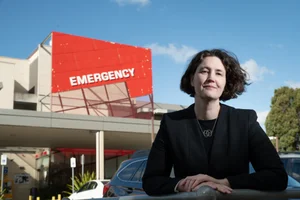
A talk delivered at the ACEM Annual Scientific Meeting, Perth, 2026
I acknowledge Whadjuk Nyoongar, the custodians of the lands on which we meet today. I acknowledge the wisdom of their elders: past, present and emerging. I acknowledge that connection to lands, seas, and skies, is integral to human health and wellbeing.
This is a heavy session, full of difficult, challenging, hard stuff. I was asked to speak with you about civility, compassion, and kindness. I decided that my job, as the opening speaker this afternoon, was to be deliberately very soft.
First, I want you to reflect on a time when you have experienced rudeness. Close your eyes, if you are into that sort of thing, and think about what happened. Sadly, I know that working in healthcare, we have probably all experienced rudeness, many times over. How did it make you feel? How did you respond? How long did it impact you? Experiencing, or even witnessing, bad behaviour takes its toll, emotionally, cognitively, and physically.
Let’s run through some etymology. ‘Civility’ shares roots with ‘civilisation’. At its heart, it means behaving as if you are part of a community, conjuring up notions of being polite or following the rules. For me, ‘civility’ is a tad British and stiff upper lip, but boundaries are appropriate in healthcare. I hope you are aware of the fabulous ‘Civility Saves Lives’ campaign from the United Kingdom. ‘Kindness’ comes from the Middle English word for family, ‘kind’, from which we get ‘kinship’. So, deep down, ‘kindness’ means treating people as if they are family. ‘Compassion’ stems from Latin; ‘pathos’, which means ‘suffering’, and ‘com’, with. Suffering together. It’s slightly different to ‘empathy’, which means ‘in suffering’. There are discussions about whether ‘compassion’ or ‘empathy’ is the right term. To me, it’s academic. They are firmly on the same spectrum.
No matter which of these words you relate to best, the way you behave and interact with others, in healthcare, is very important. We are all members of a community and belong to a family. We all experience and bear witness to suffering.
To me, civility, kindness, and compassion are fundamentally linked to inclusion and equity. I worry about telling people experiencing racism and misogyny to be kinder without doing enough to address systemic discrimination that impacts them. On the flip side, no health system is truly kind unless it allows people to be their full selves. Civility, kindness, and compassion are also the foundational building blocks of clinician wellbeing, or, as I prefer to think of it, workplace health and safety. To thrive in their roles, clinicians need to first feel that they are respected, valued, and that they belong.
Let’s contemplate identity next. It’s complicated. Have a quiet think about your own identity. You might consider things like your gender, race, sexuality, class, or how your body and mind work, as core to your identity. Also, your culture, language, religion, or political beliefs. Your family probably matters, as well as your home town, and maybe your job, pets, hobbies, your footy team, or favourite music. Significant life experiences are likely to have shaped your identify, which shifts over time, and carries different weight in different contexts. The total is far more than the sum of its parts.
Some aspects of your identity might be visible. Many more are invisible. I worry that we focus too much on the visible, or on what we assume about people based on their appearances. We each make choices about which invisible aspects of our identity we reveal to others. I acknowledge that as a white woman from the northern suburbs of Sydney, I have far more choice about which aspects of my identity I reveal than many of you do. I am playing the game of life on a relatively easy setting.
Psychological safety has taken centre stage recently. I want to remind you that safety is not comfort. Safety, like kindness, requires us to face up to difficult things, not to just brush over them, because they feel uncomfortable. Trauma-informed care is a related concept. It requires us to look beyond behaviour and understand and address its causes. Trauma-informed care doesn’t mean we let people off the hook, instead, it means that we meet people where they are at and do our very best to help them heal, with patience, genuine accountability, and without unnecessarily exacerbating or deepening their wounds.
Growing up, my mum had a fantastic saying: ‘Assumption is the mother of all fuck-ups’. None of us like being judged. I am not an especially private person, but there is so, so much stuff about me that most other people don’t know. Because I know this about myself, I assume this is also true for all of you. When people make assumptions about me, I hope they assume good things. I hope they recognise my strengths. I hope they are kind. I very deliberately try to assume good things about other people. At work, I choose to assume that my colleagues are intelligent, well-educated, and want to do a good job, and I choose to assume that patients are telling the truth, and have sought emergency care because they need it and hope to get better.
In our current climate, we do a lot of broadcasting, but not nearly enough connecting. There is a lot of very specific advice floating around about how to behave and how not to behave. Not all of it is evidence-based or relevant to everyone. Consider an example that applies to me – a list on the internet, very well-intended, of ten things not to say to someone who has had a miscarriage. No blog post can sum up the full gamut of that experience. And no-one can memorise all these lists or get things just right all the time. Take online advice with a grain of salt – weigh it up, use what works for you, and trust your instincts. In most cases, an attempt at communication, even a clumsy one, is better than no attempt at all. I worry that we are making things too difficult and creating barriers to connection. We humans have far more in common than divides us. In these times of political upheaval, it is more important than ever that we reach out to each other, especially to those with whom we disagree, and try to find shared ground. All change, whether by evolution or revolution, begins with conversation.
Through the Diversity and Inclusion Steering Group, I was involved in developing the College’s core values: equity, respect, integrity, and collaboration. Thank you to Simon Judkins for initiating that work when he was President. I know the core values, nearly ten years down the track, need review, and I believe it is coming soon. I used to be a core values sceptic. These days, I am a true believer. The core values set clear expectations for how we interact with others and provide a useful framework for holding difficult conversations about our behaviour. I am such a core values nerd that, a few years ago, I dedicated some effort to identifying my own personal core values, which are curiosity, empathy, and respect. I find that these values serve me well in all aspects of my life. They help me to have conversations, and learn about other people, even when I start out not knowing much about their background, their identify or their experiences, and hold myself to account. You might consider coming up with a set of core values of your own.
Do you have someone in your life who has the knack of making you feel special? For me, that person is my cousin, Emo. You could rock up to his place, unannounced, and even if he had just made himself a bowl of ice cream, and sat down to watch his favourite show, he would make you feel like there was nothing in the world he wanted to do more than talk with you, right now, for as long as you need. Mostly, he and I chat about music; he plays guitar and I play piano. I hope you all have someone in your life a bit like that. I feel lucky to have studied Emo, and others with the valuable skill of making people feel important, up close.
Mostly, it is about doing the simple stuff well. Know someone’s name. Their actual name, that they like to be called, not the embarrassing nickname that somebody else made up for them at work. Mirror their body language and posture, including making as much, or as little, eye contact as they want, or the subject demands. Have you all noticed that intimate conversations work best during long car trips? Most importantly, it is about listening actively, being present, and having patience. Not interrupting. Giving people the time they need. Acknowledging and validating their feelings and experiences.
Have you all heard about ‘phatic’ communication? From ‘phatos’, which means ‘to speak’ in Greek, this is communication used to build social connection, not to transmit information. It is the sort of stuff you probably don’t think about much, like greetings and small talk, but you really notice when it is not there. It drops away when we are busy, stressed, or tired, and when it does, it can feel dehumanising. Please look it up and think about how it works in your everyday interactions. A basic rule I follow is that if I think something nice about someone, I tell them.
I want to raise something difficult now. I think many of us in emergency medicine are driven by ‘not-enoughness’. I often feel that I am not enough, and I suspect many of you do too. This can inspire us to do amazing, courageous, and important things. But – I know that I need to be careful, when overcoming my own ‘not-enoughness’, to not, inadvertently, become ‘too much’ for someone else. Personally, I have had to work very hard at creating space for other people, especially when I really care about an issue but have less skin in the game than other stakeholders. Only you can judge what is right for you.
I want to reflect on making mistakes. As I said earlier, no-one is perfect. No-one always gets it right. But please try. In my experience, people can tell when you have genuine, good intentions; curiosity, empathy, and respect. When you make a mistake, own up, apologise, and learn. Do better next time. Please try and keep trying.
Can you think about a time when you were new? This might be in any context – work or social. Think about someone who made you feel welcome when you were new. What did they do? What did they say? This is my life hack when interacting with people I don’t know well or in awkward situations. I just try to be that person.
My son likes to make comic books. Several years ago, as I was leaving for a College trip, he handed me one of his books. It was tiny – about 3cm by 5cm – two ragged pages stapled together. ‘MUM!’, it shouted, in mostly capital letters. ‘THIS iS A STORY ABOT LOVe [sic]’.
I don’t know which love stories you have had in mind, if any, as we have wandered through this talk together. It doesn’t really matter. There is love all around us in emergency medicine. The stories, the drama, the triumphs, the friendship, and the human connection. There is so much romance in our everyday work. We are lucky to do what we do. We are surrounded by love. Sometimes, we just need to remember to stop and look for it.
I was diagnosed with cancer in an emergency department at 930pm on Friday night. Statistically, this is a cliché. After knowing something was wrong for months, and playing cat and mouse with my GP for a week, she called me on Friday afternoon and told me to go to hospital. I was in the privileged position of being able to ring around and find out who was in-charge at the emergency departments close to home. I chose the emergency physician who broke very bad news to me that night because of his kindness and compassion.
I was diagnosed with cancer on Friday. Emo was diagnosed the following Tuesday. We went through treatment together; our stories are intertwined. He died in March and I miss him.
Civility, compassion, and kindness really matter. Your behaviour makes a difference, as a clinician, and as a colleague, carer, and patient. Let’s face it. At some stage, we each play all of these roles.
Sprinkle love around, liberally. You will probably find you get back what you give out, and more. Please don’t forget to save a little bit for yourself.
Thank you for listening.
With enormous thanks to my colleagues at Royal North Shore Hospital, who looked after me, and Emo, with civility, compassion, and kindness.